By Robin Murphy
There’s a cabinet above my bathroom sink called the medicine cabinet.
Here’s what’s in it: toothpaste, dental floss, tweezers, Band-Aids, a thermometer, three things I bought for my skin and can no longer remember what they do, and maybe some medicine. I’d have to check.
I’ve opened that cabinet, and every one before it, something like ten thousand times, and it never once occurred to me to ask why it’s called that. It’s just the name. Like the glove compartment, which hasn’t seen a glove in decades.
But once you ask, the question gets worse. Because the bathroom is not a great place for medicine.
Think about what a bathroom actually is. It’s a small room where we run hot water for twenty minutes, fog the mirror, then shut the door so it can steam a while longer. If you set out to design a room that’s hard on pills, you’d have trouble beating it. The FDA puts it more politely: keep medicines somewhere cool and dry.
So we built a special cabinet for medicine and put it in the room medicine may enjoy least.
I wanted to know how that happened. The answer, it turns out, is that the medicine was never really the point.
For a long time, medicine lived in the kitchen. That’s where remedies got mixed, heated and measured, sometimes in the same pots used for dinner. Then indoor plumbing arrived and the bathroom got a promotion. It stopped being just the place you washed and became the place you took care of yourself. Teeth, shaving, cuts, combs. All of it drifted into one small room, and the medicine drifted along with it.
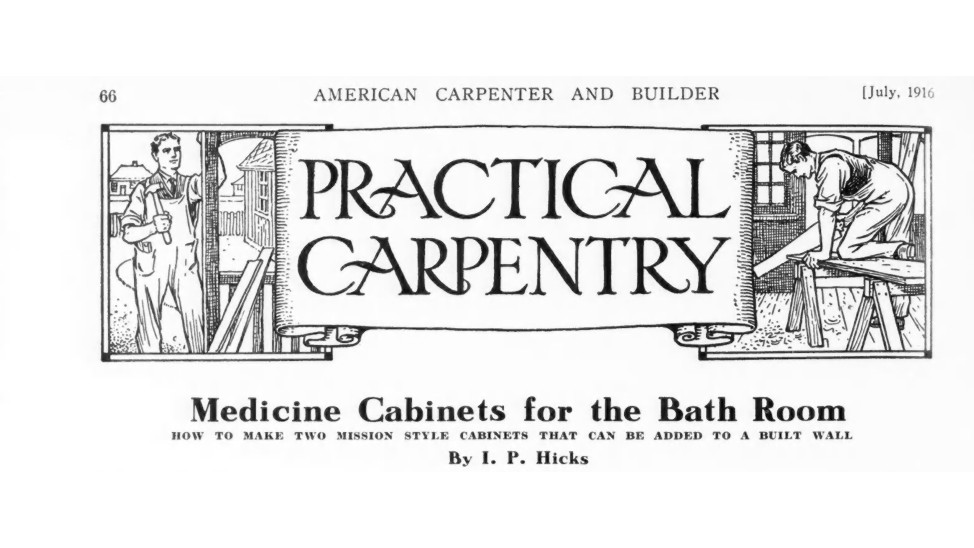
By 1916, a magazine called American Carpenter and Builder was describing the medicine cabinet as an almost indispensable part of the modern bathroom, good for holding “toilet preparations and medicine.”
Toilet preparations first, you’ll notice. Medicine second.
That was the cabinet right from the start. Aspirin beside the shaving cream. Iodine next to the cold cream. A thermometer, a razor, a comb.
It was never just a medicine cabinet. It was where all the little things we use to take care of ourselves ended up, and medicine happened to get naming rights.
What I love is that nobody ever went back and fixed it. We learned that heat and humidity weren’t doing medicine any favors, and the cabinet stayed exactly where it was, with exactly the same name.
We kept putting aspirin in it because that’s where aspirin goes.
Houses are full of this. Decisions somebody made once, for perfectly good reasons, that quietly became permanent. A generation or two later, we stop seeing them as decisions at all. They’re just how houses work.
And honestly, the cabinet’s fine. It’s a great place for the things we use standing at the sink: toothpaste, floss, contact lenses, face cream, razors, nail clippers and the mysterious little scissors nobody remembers buying.
It’s an excellent bathroom cabinet.
It’s just not necessarily an excellent medicine cabinet.
We probably should have renamed it years ago. But “the cabinet full of tiny things we use on our bodies” never caught on.