A white toilet has no secrets.
A stray hair shows. A drip shows. A faint ring shows. You can tell pretty quickly whether it’s been cleaned.
Which makes it a strange choice for a toilet. If the goal were simply to have a bathroom that looked clean for as long as possible, we wouldn’t choose the color that reveals absolutely everything.
It turns out, we didn’t always.
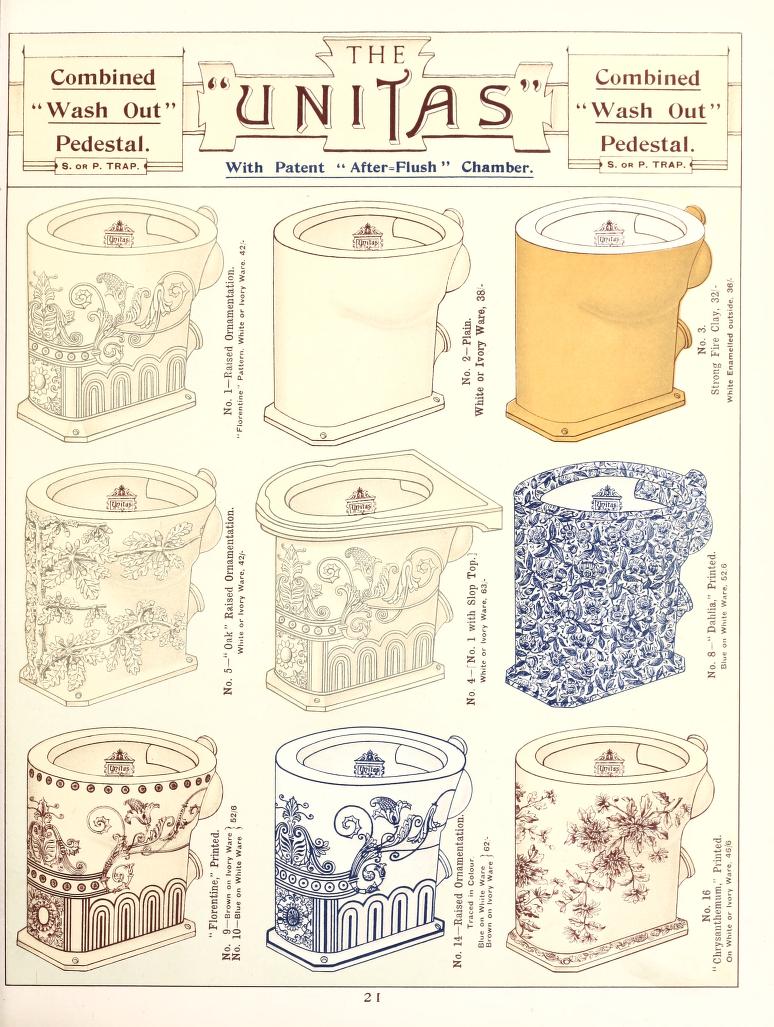
In 1884, Thomas Twyford, one of Britain’s leading manufacturers of sanitaryware, advertised toilet bowls and other fixtures in “White, Printed, Gilt and Decorated.” The same advertisement said Twyford’s products were being used in British dockyards, barracks and military and naval hospitals, and recommended by doctors, architects and sanitarians.
Decorated. As in patterns and ornament. Some Victorian toilet bowls looked less like the plain white fixtures we know today and more like very large pieces of china.
And apparently nobody thought there was anything unsanitary about that.
So the more interesting question isn’t really why toilets are white. It’s how white became the color that looks sanitary to us.
Part of the answer seems to begin with something other than color.
For much of the 19th century, toilets could be enclosed in woodwork. They looked more like furniture, with the plumbing and ceramic bowl tucked away inside.
Then Twyford introduced the Unitas, a freestanding toilet much closer to the fixture we recognize today.
His advertising explained why that mattered. Because the toilet was exposed, filth and sources of bad smells couldn’t “accumulate or escape detection.”
I love that phrase because it gives away the whole idea.
The problem with the old toilet wasn’t just that dirt might be there. It was that dirt could be there without you knowing it.
And people had plenty of reasons to be nervous about what they couldn’t see.
For decades, Americans worried about “sewer gas,“ foul vapors thought to rise through plumbing and cause disease. Then germ theory came along and changed the explanation, but not the basic fear: something dangerous might be in your house even if you couldn’t see it. By around 1910, germ theory had largely displaced sewer gas as the more convincing explanation for disease.
Once you’re worried about invisible contamination, hiding the plumbing starts to seem like a pretty bad idea.
So bathrooms changed. Woodwork disappeared from around toilets. Surfaces got smoother. Cracks and crevices became suspicious. Hard, washable materials made more sense.
And this is where white starts to make a lot more sense too.
By the early 1900s, plumbing manufacturers were explicitly connecting whiteness with sanitation.
A 1906 Standard Sanitary advertisement praised the “snow-white purity” of its fixtures while emphasizing smooth surfaces and the absence of cracks where dirt could lodge. Then it promised that “Health, purity, cleanliness” would radiate through a house equipped with them.
That’s the part that gets me. We’re not looking backward and guessing that white must have symbolized cleanliness. They were selling the association right there.
Of course, white itself wasn’t what made a toilet sanitary.
The glazed, nonabsorbent surface mattered. Better plumbing mattered. Fewer cracks and places for grime to collect mattered. A blue toilet made from the same material wouldn’t suddenly become less hygienic.
But white offered something else. You could see what was on it.
I’ve cleaned enough bathrooms to know that color changes what you see. On a white toilet, a faint ring announces itself. On beige or patterned fixtures, the same buildup can sit there much more quietly.
The very quality that makes a white toilet slightly annoying to keep looking clean also makes it reassuring when it is clean. There’s less camouflage. A surface that shows dirt gives you information about whether the dirt is gone.
And once manufacturers started pairing that visibility with words like health, purity and sanitation, white became more than a color.
It became part of what clean looked like, and that association stuck.
We no longer worry that a wooden toilet enclosure might be hiding deadly sewer vapors. Most of us aren’t thinking about germ theory when we choose a bathroom sink. A black, blue or pink toilet can be just as hygienic as a white one. But white doesn’t have to make its case anymore.
It just looks clean.
Eventually, we forgot the argument and kept the aesthetic.
I started out thinking white was an odd choice for a toilet because it shows everything. It turns out that’s a reason it became a convincing choice in the first place.
At the moment when bathrooms were being redesigned to expose what had once been hidden, an unforgiving color wasn’t necessarily a disadvantage. It was reassurance.
Nobody exactly decided that toilets should be white.
We decided that clean should be a color.