By Robin Murphy
Nothing about a clean house naturally smells like a lemon.
Countertops don’t produce citrus. Neither do freshly mopped floors, clean sinks, or toilets. And yet open a bottle of household cleaner and there’s a pretty good chance somebody has decided a lemon belongs in there.
So where did the lemon scent come from?
Lemon didn’t get the job entirely through marketing. Citrus has a legitimate history in cleaning. Lemon juice contains citric acid that can help dissolve mineral deposits, and citrus peels contain limonene, a solvent that can help dissolve oils and grease. Long before there was a cleaning-products aisle, citrus had practical uses around the house.
So the original connection made some sense. You cleaned something with lemon, and afterward it smelled like lemon.
But lemon wasn’t always America’s favorite smell of clean. For a long time, that job belonged largely to pine. Pine-Sol was created in 1929 using pine oil, and the smell became so closely associated with house cleaning that generations of people learned to recognize pine as evidence that somebody had been at work.
But by the 1980s, lemon wasn’t merely another cleaning scent. It was taking over the aisle.
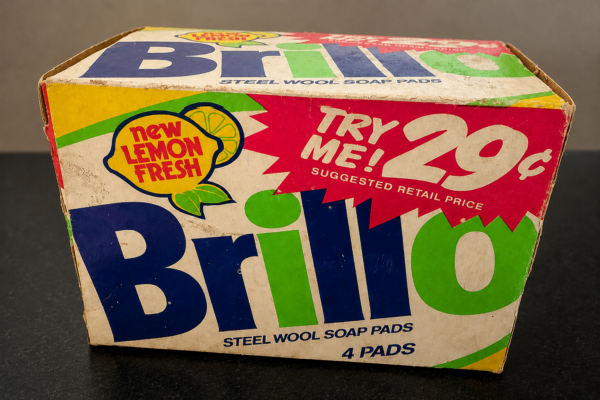
A 1987 Los Angeles Times article captured the change while it was happening. In just 21 months, at least 78 lemon-scented household and laundry products had been introduced. Mr. Clean had gone lemon. Comet had gone lemon. Windex had gone lemon. Cascade was introducing lemon. Even Brillo had a lemon-fresh soap pad. An executive at International Flavors & Fragrances told the paper that lemon had become, by far, the most popular scent in household cleaning products.
The numbers were pretty remarkable. Sales of lemon-scented household cleaning products had reached nearly $430 million in 1986 and were growing, while sales of pine-scented products had slipped.
By then, something interesting had happened. The lemon smell didn’t necessarily have much to do with the thing doing the cleaning.
The same Los Angeles Times article noted that in many of these products, the lemon scent wasn’t coming from lemons at all. Manufacturers could create or add a citrus fragrance separately. Lemon had gone from being something that could actually help clean to being a smell that told us cleaning had happened.
Which is a pretty impressive promotion for a fruit.
In a 2005 series of experiments, researchers exposed people to the scent of a citrus-scented all-purpose cleaner without drawing their attention to it. The scent made cleaning-related thoughts more accessible, and in one experiment, people exposed to it showed more cleaning-related behavior. Later, research has cautioned that scent-priming effects aren’t always that simple, but the association itself is hard to miss.
We didn’t just put lemon into cleaning. Cleaning put something into lemon.
After decades of encountering citrus in products made for kitchens, bathrooms, floors, laundry, and almost everything else in the house, lemon came to carry information of its own. The scent could announce that cleaning had taken place whether or not an actual lemon had been anywhere near the room.
That’s a strange little trick. The cleaner and the fragrance can be doing completely separate jobs. One removes soil. The other tells our nose a story about what just happened.
There’s nothing wrong with liking the smell of lemon. Plenty of people do.
But somewhere along the way, lemon stopped being merely something that might help clean and became something that could make a room seem clean.
The cleaning product does the work.
The lemon tells us how to feel about it.