I think about baseboards all the time, but mostly because of cleaning.
They collect dust. They get scuffed. Vacuums bang into them. A room can look clean until you notice that thin gray line sitting along the top.
But I always thought baseboards themselves were really about construction and decoration. They cover the place where the wall meets the floor, and they make a room look finished.
Then I learned that Americans used to call them mopboards.
And that changed what I thought I knew about them.
Cleaning wasn’t just something that happened to baseboards. It was part of why they were there.
The bottom of a wall is exactly where a wet mop, broom, shoe, furniture leg or anything else moving across a floor is going to hit. The board takes that abuse so the wall doesn’t have to. Merriam-Webster dates the word mopboard to at least 1845.
At Mount Vernon, that connection is still visible. Preservation work in the New Room found that its mopboards had been painted dark gray, black and brown at different times. The dark colors weren’t just decorative. They helped hide the dirty smudges left when floors were mopped against them.
The board took the mop.
Today, we tend to look at baseboards as trim. We pick a height, a profile, a paint color. But mopboard reminds you that the bottom of the wall was also a place where housework happened.
What I find especially funny is how completely the logic has reversed.
Mount Vernon’s dark mopboards were practical because they hid the marks left by cleaning. Today, baseboards are so often painted white that every scuff, shoe mark and gray line of dust announces itself.
We took a piece of the room that was designed to absorb wear and turned it into one of the easiest places to see whether a house has been cleaned recently.
There’s another wonderful Mount Vernon detail. When preservation carpenters removed one of the New Room’s mopboards, they found a penciled name and date on the back: DP Billingsley, September 20th, 1884.
Someone had written his name on the side nobody was supposed to see, put the board back, and left it there for about 140 years.
That seems almost too perfect for a baseboard, because hiding things is more or less its job.
Walls and floors don’t always meet as neatly as they appear to. Flooring has edges. Plaster and drywall have edges. Wood moves. Cuts aren’t perfect. Sometimes there needs to be a gap. A baseboard covers that awkward meeting point and makes it look deliberate.
The British call it skirting, which is another very literal name. In 1911, the Encyclopædia Britannica described skirting as doing three jobs: decorating the bottom of the wall, covering the joint where wall and floor meet, and protecting the wall from damage.
Once you need a board there anyway, it makes sense that people started dressing it up. Baseboards became part of the architecture of a room, along with chair rails, paneling and cornices. Colonial Williamsburg describes them in early American houses as bands of wood running around the bottom of plaster walls or wainscoting, and by 1911 Britannica was distinguishing between simple skirting boards and more elaborate “built-up” versions made from several pieces of molding.
So the practical board became decoration too. Somewhere along the way, we got very good at seeing the molding and forgetting the mop.
An 1886 issue of Ladies’ Home Journal and Practical Housekeeper gives a glimpse of the older relationship. A woman writing about cleaning a farmhouse kitchen mentions wiping the corners and the mopboard with a damp floor cloth. She doesn’t stop to explain what a mopboard is. She doesn’t need to.
That’s one of the things I like about old household words. Sometimes they preserve the purpose of an object better than the word we use now.
Baseboard tells you where it is.
Mopboard tells you what happened there.
There was one small problem with the whole arrangement. The board covered the crack where the wall met the floor, but it also created another crack where the board met the floor.
And if you’ve ever cleaned a baseboard, you know exactly what happens there. Dust and grime settle into that seam, especially in corners, and it can be annoyingly hard to get completely clean.
So I have some sympathy for the people who decided this was a design flaw.
A 1906 advertisement for Crown Sanitary Flooring promoted a floor that curved upward into the wall instead of meeting a separate baseboard. The ad described the ordinary seam as a “receptacle for dirt, disease germs and insects.”
Even Britannica warned builders to plaster behind skirting so the hollow space wouldn’t become a “harbourage for vermin.”
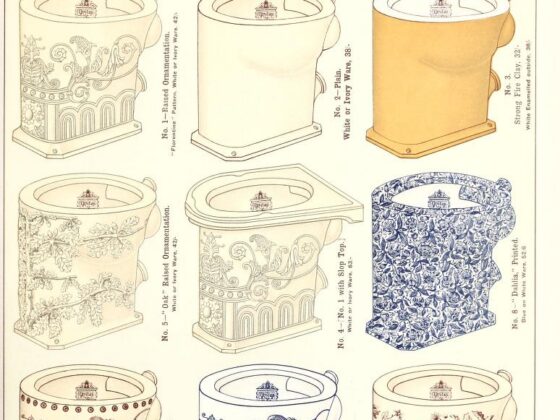
That larger sanitation story also shows up in the history of the white toilet, but here the complaint is wonderfully specific: the baseboard solved one dirty edge and created another.
And yet baseboards survived, probably because the thing they were solving never went away.
Modern hardwood floors still need space around their edges so the wood can expand and contract, and that space is usually hidden with trim.
So there may be a gap running around the edge of your room right now. You just don’t see it.
That’s what baseboards are very good at. They cover the awkward part. They protect the wall. They hide the edge of the floor. They make the room look finished.
Now, when I look at a baseboard, I still see the construction and the decoration. But I also see the mop hitting it, the dark paint hiding the marks, and a carpenter writing his name on the back.
I also see that thin gray line of dust along the top.
I used to think of that dust as something baseboards happened to collect.
Now I see it as part of the job.