One of the hardest things to do while cleaning is nothing. Spray the shower wall and wait. Spray the stovetop and wait. Put cleaner in the toilet and walk away.
Most of us don’t. We spray something, pick up a cloth and immediately start wiping. If the dirt doesn’t come off, we scrub harder. Then we decide the cleaner isn’t very good.
Sometimes the missing cleaning tool is time.
Cleaners need a chance to work. Grease has to soften. Soap scum has to loosen. Dried food has to rehydrate. And if you’re using a disinfectant, the surface often needs to stay visibly wet for a specific amount of time listed on the label.
This is called dwell time, which sounds much more technical than what it is. You put the product on. You leave it alone. The only skill involved is not standing there watching it.
If I spray a shower and then wait three minutes while staring at the wall, those three minutes feel ridiculous. If I spray the shower and clean the sink, wipe the mirror or empty the trash while the product sits, the waiting disappears.
That is one of the small differences between cleaning randomly and cleaning in an order. You start with the things that need time, then go do something else. By the time you come back, the product has had a chance to do part of the work for you.
This matters most on the jobs people tend to attack: a greasy stovetop, a bathtub ring, toothpaste dried onto a sink, something mysterious that cooked itself onto the bottom of the microwave three days ago.
Our instinct is usually more force. More scrubbing. More product. A rougher sponge. Maybe a second cleaner, because surely two chemicals are better than one.
Sometimes the smartest thing you can do is make the mess easier to remove before you try to remove it.
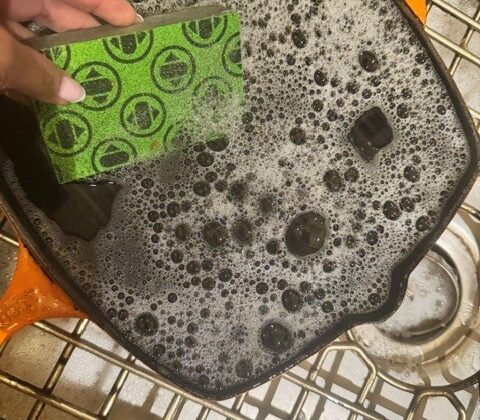
Think about a plate with dried food on it. You could stand at the sink scraping away at it, or you could let it soak. Nobody considers soaking lazy. We understand instinctively that water needs time to get into the dried food and soften it.
Dwell time is the same idea, just applied more broadly.
There is, however, one important catch: more time is not always better. Cleaning products are chemicals, even the familiar ones, and surfaces are materials. Leave the wrong product sitting too long and you can dull a finish, discolor metal, damage stone or create a different problem from the one you started with.
So the useful rule isn’t spray everything and go have lunch. It’s: give the right product the amount of time it needs, on a surface that can handle it.
Disinfectants are where this matters most. The label says how long the surface has to stay wet, often several minutes, and if it dries or gets wiped before then, you cleaned it, but you didn’t disinfect it.
For ordinary cleaning, the timing is usually less dramatic. Often you are simply giving the cleaner enough time to loosen what you’re about to wipe away. You can usually tell when that has happened: the grease stops feeling glued down, the dried toothpaste wipes instead of chips, and the bathtub stops requiring upper-body training.
There is something satisfying about a cleaning product that works instantly. Spray, swipe, gone. It feels fast. And speed is easy to sell. Every bottle in the cleaning aisle can promise fast action; “leave it alone for four minutes” is a much harder pitch.
But some of the most efficient cleaning looks slower at first.
The product sits. You leave. Nothing seems to be happening.
Then you come back and the job that would have taken five minutes of scrubbing takes thirty seconds.
A lot of cleaning advice tells us what to use. Sometimes the better question is how long to leave it there.