I have a notebook problem.
It isn’t critical. More chronic. I have notebooks in drawers, on shelves, beside my bed, in my bag. Some have a purpose. Most began with one.
The other day I was looking through one of them for something specific when I found something else I’d written down and completely forgotten:
Clarity = signal / noise
Underneath it, I had written: Claude Shannon.
I had no memory of writing either thing, so instead of finding whatever I had originally opened the notebook to find, I looked up Claude Shannon.
Shannon was a mathematician at Bell Labs who, in 1948, published a paper that became the foundation of information theory. He was interested in a problem that sounds technical because it was: How do you transmit information accurately when there is interference along the way?
Think telephone lines. There is the message you are trying to send. That is the signal. Then there is everything interfering with it.
The noise.
Shannon developed a mathematical way of thinking about information, transmission, uncertainty and noise. I will spare you the equations, partly as a public service and mostly because I do not understand them.
But I couldn’t stop thinking about the basic idea, because once you start looking for signal and noise, you see them everywhere.
“I hope this email finds you well.”
Noise.
Nobody has ever read that sentence and thought, Thank goodness. This email found me. We step over it on our way to the part of the email that actually means something.
Homes have noise too.
Not necessarily clutter. That’s the obvious version of this story, and I don’t think it’s quite the same thing.
A house can have plenty of things in it and still feel peaceful. Books, art, photographs, furniture, a bowl on the table, twenty magnets on the refrigerator. Those things may be part of what the house is saying.
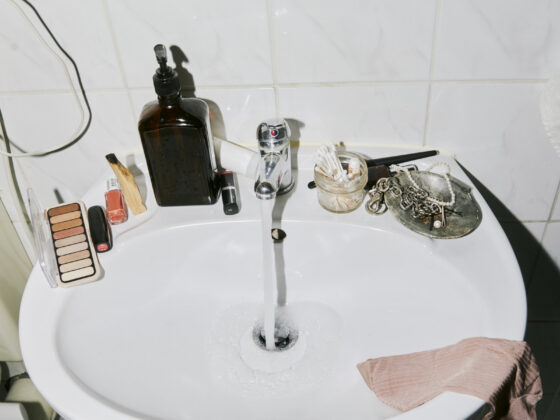
The noise is different. It’s the stack of mail that has been sitting on the counter long enough to become furniture. The toothpaste dots on the mirror. The shoes that migrated halfway across the entryway. The crumbs near the toaster. The blanket that fell halfway off the sofa yesterday and has remained there ever since.
None of these things is a crisis. Most of them are barely worth noticing.
Except we do notice them. That’s what interests me.
One of the strangest things about cleaning is how little can physically change while the room itself seems to change enormously. The sofa is still the sofa. The table hasn’t moved. The kitchen is exactly the same size.
We haven’t remodeled anything. We haven’t thrown away anyone’s belongings or replaced the furniture or knocked down a wall. And yet someone walks in and says some version of the same thing:
It feels so much better in here.
What changed?
Some of it is obvious. Dirt is gone. The room smells different. Things shine. But I think something quieter happens too: the room contains fewer interruptions.
Our visual systems are constantly sorting what is in front of us. Objects compete for our attention, whether or not we consciously decide to give it to them. A countertop covered with unrelated things offers the brain more separate objects to register than the same counter cleared off. A smudge on a mirror breaks an otherwise continuous surface. Crumbs interrupt a floor.
Cleaning removes some of those interruptions. Not everything needs to disappear. The background just gets to become the background again.
I think this may explain something I have noticed for years without having language for it.
Consider a freshly made bed.
Nothing has been removed from the room. In fact, all the same bedding is still there. But before the bed is made, you see the sheet, the blanket, a pillow at an angle, another pillow partly covered, folds, wrinkles, edges.
Make the bed and suddenly those separate things read as one thing:
Bed.
The objects haven’t gone anywhere. Some of the static has.
That distinction matters because we tend to talk about cleaning as if its entire purpose were sanitation or appearance. But people don’t experience their homes as inspection reports.
They experience them while walking through the door tired. While trying to make dinner. While searching for their keys. While having a conversation. While sitting on the sofa at the end of the day.
A hundred tiny things can ask for a sliver of attention without any one of them being important enough to deserve it. Maybe that’s why a room can feel harder before it is cleaned. Not filthy. Not even messy. Just noisy.
This also explains why the effect can be so disproportionate to the work. Wiping a bathroom mirror takes maybe a minute or two, but afterward, the entire bathroom can look different. Vacuuming doesn’t change the furniture, yet somehow the room looks finished. Clearing and wiping a kitchen counter might expose only a few extra square feet of stone, but suddenly the kitchen feels larger.
We usually describe that as “clean.” I’m beginning to wonder whether part of why a clean room feels better is clarity.
Not the minimalist kind where you are expected to own three beige bowls and hide the toaster. I mean visual clarity.
The room makes sense again.
There is another reason I like thinking about cleaning this way: it separates cleanliness from emptiness.
A house does not have to be sparse to feel good. Some of my favorite homes are full of things. Books stacked everywhere. Art covering the walls. Children’s drawings on the refrigerator. Collections that have clearly been collected by someone who loves collecting them.
Those things are signal. They tell you who lives there.
Cleaning shouldn’t erase that. In fact, maybe good cleaning does the opposite. It removes enough noise that you can see the home more clearly.
The painting instead of the dust on its frame. The kitchen counter instead of everything that has temporarily landed on it. The old wood floor instead of the grit sitting on top of it.
The room instead of its interruptions.
Claude Shannon was trying to figure out how to get a message through a noisy communication channel. I don’t think he was thinking about fingerprints on stainless steel.
But ever since I found his name in that notebook, I keep thinking about kitchens.
Because maybe this is part of what happens when we clean a home.
The room doesn’t stop saying anything.
You can finally hear what it was trying to say.